Using a manual wheelchair for long periods can place a heavy strain on the shoulders and arms, especially on slopes or during long-distance travel.
Power-assist support for manual wheelchairs is designed to reduce that physical burden and help wheelchair users travel more independently.
However, there is no single nationwide program that automatically covers the purchase cost for every registered person with a disability. Available support depends on factors such as place of residence and employment status.
By checking the 2026 application period, eligibility requirements, deposit, and application process, it becomes much easier to understand which program may apply.
Table of Contents
1. What Is a Manual Wheelchair Power-Assist Device?
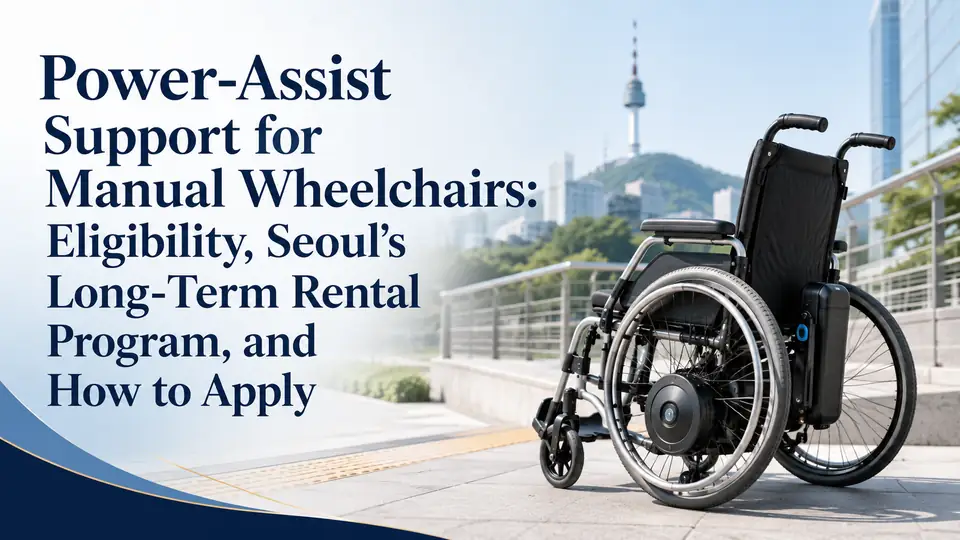
A manual wheelchair power-assist device is an electric mobility aid attached to an existing wheelchair to provide motorized assistance.
It allows users to keep many of the practical advantages of a manual wheelchair while receiving additional power on slopes, uneven roads, or during longer trips.
When looking into power-assist support for manual wheelchairs, compatibility with the user’s current wheelchair should be checked before focusing on the price or performance of a product.
Main Features of Power-Assist Devices
| Category | Details |
|---|---|
| Main types | Wheelchair propulsion device or front-mounted drive unit |
| Main purpose | Assistance with long-distance travel and slopes |
| Expected benefit | Reduced strain on the shoulders and arms |
| Control method | Handle, switch, or joystick |
| Key checks | Frame compatibility, weight limit, brakes, and battery |
The size, weight, and attachment method can vary considerably from one device to another.
For people who regularly transport their wheelchair in a car, it is also important to check whether the device can be removed and reattached without assistance.
Rather than choosing a product immediately, it is safer to receive an assessment from an assistive technology center based on the user’s physical condition and daily environment.
Related link: National Assistive Technology Center product database
2. Who Is Eligible?
Seoul’s 2026 program is open to registered residents of Seoul with a physical, brain lesion, cardiac, or respiratory disability.
Applicants are selected after document screening and an on-site assessment to determine whether a manual wheelchair and power-assist device are necessary for daily life.
For this reason, power-assist support for manual wheelchairs is not automatically approved simply because a person is registered as having a disability.
Seoul Eligibility Requirements
| Requirement | Details |
|---|---|
| Residence | Seoul |
| Disability registration | Required |
| Eligible disability types | Physical, brain lesion, cardiac, or respiratory |
| Selection process | Document screening and on-site assessment |
| Number of recipients | About 40 people |
| Selection announcement | Expected in late September 2026 |
During the assessment, the center may review the applicant’s usual travel distance, home environment, use of slopes, and ability to operate the device safely.
Preparing the manufacturer, model name, full wheelchair photos, and close-up photos of the frame connection points can make the consultation easier.
When a family member or personal assistant contacts the center on behalf of the user, it is helpful to explain the actual daily travel environment in detail.
Related link: Seoul Metropolitan Government announcement
3. What Does the Program Cover?
Seoul’s power-assist support for manual wheelchairs is not a reimbursement program and does not transfer ownership of the equipment to the recipient.
A manual wheelchair and a suitable power-assist device are provided together as a set for long-term rental of up to three years.
The rental fee is free, but recipients must pay a security deposit equal to 10% of the equipment price.
Support Details at a Glance
| Category | Support provided |
|---|---|
| Equipment | Manual wheelchair and power-assist device set |
| Rental period | Up to three years |
| Rental fee | Free |
| Security deposit | 10% of the equipment price |
| Number of recipients | About 40 people |
| Follow-up support | Equipment selection, training, and usability assessment |
The term “free rental” can make it seem as though there are no upfront costs, but the deposit must still be paid.
Because the equipment is rented rather than permanently provided, users should also check maintenance responsibilities, return conditions, and damage policies before signing the agreement.
The program does not reimburse equipment purchased in advance, so it is important not to buy a device before the selection process is complete.
4. How to Apply and What Documents Are Needed
The application period for power-assist support for manual wheelchairs runs from July 27 to August 20, 2026.
Applications may be submitted in person or by email to the Seoul Assistive Technology Center responsible for the applicant’s registered address.
After document screening and an on-site assessment, final results are expected to be announced in late September through the center’s website and individual notification.
Application Centers by District
| Center | Districts covered | Contact |
|---|---|---|
| Northeast Center | Nowon, Dobong, Gangbuk, Jungnang, Seongbuk, Dongdaemun | 02-6926-6952 |
| Southeast Center | Gangdong, Gwangjin, Seongdong, Songpa, Gangnam, Seocho | 02-440-5895 |
| Northwest Center | Mapo, Seodaemun, Eunpyeong, Jongno, Yongsan, Jung-gu | 02-6070-9264~9 |
| Southwest Center | Gangseo, Yangcheon, Guro, Yeongdeungpo, Geumcheon, Dongjak, Gwanak | 070-4878-3695 |
Application Process
- Check which center covers the applicant’s registered address.
- Download the application form and official announcement.
- Prepare proof of disability registration and residence.
- Submit the application in person or by email.
- Complete document screening and an on-site assessment.
- Check the final selection result and pay the deposit.
- Select suitable equipment and receive user training.
The phone number and email address on the application should be entered correctly so that important updates are not missed.
Additional documents may be requested depending on the applicant’s situation, so calling the center before preparing the paperwork can save time.
Applications may increase near the deadline, making it safer to submit the documents several days in advance.
5. Support Programs Outside Seoul
People who live outside Seoul may still be eligible for support through the Korea Employment Agency for Persons with Disabilities assistive technology program if they are employed.
This program supports the purchase or rental of assistive technology needed for work. Eligible applicants may include employees with disabilities, public officials with disabilities, employers who hire or plan to hire people with disabilities, and certain business owners with disabilities.
Eligible products may include manual wheelchair propulsion devices and front-mounted power units.
Korea Employment Agency Support
| Category | Details |
|---|---|
| Standard support limit | Up to KRW 15 million per person |
| Additional support limit | Up to KRW 20 million for eligible applicants |
| Main applicants | Employees and public officials with disabilities, eligible employers |
| Eligible equipment | Registered propulsion and drive devices |
| Where to apply | Regional branch responsible for the workplace |
| Personal contribution | May be required depending on product cost |
Approval is not guaranteed for the exact product requested.
A different device may be recommended based on consultation, job assessment, and compatibility with the person’s work duties.
The key consideration is whether the equipment is necessary for performing work and maintaining employment, rather than simply improving convenience in daily life.
6. How Is It Different from National Health Insurance Coverage?
Korea’s National Health Insurance assistive device benefit includes several types of wheelchairs, such as standard manual wheelchairs, active wheelchairs, tilt-in-space wheelchairs, reclining wheelchairs, and electric wheelchairs.
However, a power-assist device attached separately to a manual wheelchair is not processed in the same way as ordinary wheelchair benefits.
Confusing power-assist support for manual wheelchairs with National Health Insurance wheelchair coverage can lead applicants to contact the wrong organization or follow the wrong procedure.
Which Organization Should Be Contacted?
| Needed equipment or support | Organization to contact first |
|---|---|
| Standard or active manual wheelchair | National Health Insurance Service |
| Tilt-in-space or reclining wheelchair | National Health Insurance Service |
| Electric wheelchair | National Health Insurance Service |
| Seoul long-term power-assist rental | Seoul Assistive Technology Center |
| Work-related propulsion device | Korea Employment Agency for Persons with Disabilities |
| Prosthetic or mobility aid for veterans | Relevant veterans affairs agency |
National Health Insurance benefits generally require eligible disability conditions, a medical prescription, and specific approval criteria.
Receiving support for a manual wheelchair does not mean that the cost of a power-assist device will also be covered automatically.
Previous support history and possible restrictions on receiving benefits from multiple programs should be checked directly with the relevant organization.
7. Important Things to Check Before Applying
The most important part of power-assist support for manual wheelchairs is not maximum speed or product performance, but whether the device is safe and suitable for the user.
Even when the same model is used, the experience can vary depending on the wheelchair frame, wheel size, user weight, hand function, and control ability.
A device that feels convenient indoors may be difficult to use on curbs, slopes, buses, subways, or uneven sidewalks.
Pre-Application Checklist
- Manufacturer and model of the current wheelchair
- Frame connection points and wheel size
- Total equipment weight and user weight limit
- Whether the device can be removed and attached independently
- Starting, stopping, and reversing performance on slopes
- Battery charging location and expected travel range
- Compatibility with cars, buses, and subways
- Availability of local repairs and maintenance
During the first trial, it is safer to use a low speed setting and practice starting and stopping on flat ground.
Users should also check restrictions for rain or snow, recommended battery storage temperature, and safe charging procedures.
When the user’s physical condition or living environment changes, the center may be able to provide a reassessment or equipment adjustment.
Frequently Asked Questions
Q1. Is every registered Seoul resident with a disability eligible?
Applicants must live in Seoul and have a registered physical, brain lesion, cardiac, or respiratory disability. However, only about 40 recipients are selected after document screening and an on-site assessment, so submitting an application does not guarantee approval.
Q2. Can the device be purchased first and reimbursed later?
No. Seoul’s program provides a long-term rental for up to three years rather than reimbursement for a personal purchase. The Korea Employment Agency program may also reject purchases made before official approval, so applicants should contact the responsible organization before buying any equipment.
Q3. Are there any options for people who do not live in Seoul?
Employed people with disabilities and public officials with disabilities may be eligible for assistive technology support through the Korea Employment Agency for Persons with Disabilities. Those who are not employed should contact their regional assistive technology center, city hall, county office, or district office to check for local programs.
Key Takeaways
- Power-assist support for manual wheelchairs is not a single nationwide cash benefit.
- The available program depends on residence, employment status, and individual eligibility.
- Seoul is accepting applications until August 20, 2026, with about 40 recipients expected to be selected.
- Selected users may rent a manual wheelchair and power-assist device for up to three years.
- The rental is free, but a 10% security deposit is required.
- Employed people with disabilities may qualify for support through the Korea Employment Agency for Persons with Disabilities.
- National Health Insurance wheelchair benefits and separate power-assist device programs are different.
- Applicants should receive compatibility and safety assessments before purchasing any device.